Shyam Cookware Knowledge Hub
Explore expert buying guides, pressure cooker safety tips, and cookware advice.
Expert Buying Guides
Learn how to choose and maintain the best pressure cookers for your modern kitchen.
Tri-Ply & Non-Stick Advice
Discover the benefits of tri-ply, non-stick technology, and LPG gas stove maintenance.
Choosing the China Best Handi Pressure Cooker Manufacturer requires more than comparing prices or polished factory photos. A dependable supplier should demonstrate practical experience, stable production, and clear quality controls. This matters because a Handi Pressure Cooker must withstand heat, pressure, repeated use, and daily handling. Small details can reveal much. Check the lid fit, gasket material, handle strength, safety valve design, and base flatness. Ask for material specifications and test records. Do not rely on attractive claims alone.
A professional manufacturer should explain its production process in plain language. It should also provide consistent samples before bulk purchasing. Useful evidence may include factory audits, product certifications, inspection reports, and customer references. However, documents do not replace careful evaluation. A sample may perform well while later batches vary. That risk deserves attention. Communication speed, packaging quality, replacement support, and export experience also influence long-term reliability. Experienced buyers often test several units under controlled conditions, rather than approving one sample immediately.
There is no universal answer.
The best supplier depends on your market, capacity, budget, and compliance requirements. A manufacturer serving household retailers may not suit commercial kitchens. Similarly, a low-cost model may require stronger inspection or improved packaging. This article will examine how to compare Chinese suppliers, verify technical capabilities, assess safety features, and identify realistic indicators of trust. It will also consider common weaknesses in supplier evaluation, because even careful decisions can miss hidden production differences. The goal is a balanced, evidence-based approach to selecting a capable Handi Pressure Cooker manufacturer.
China Best Handi Pressure Cooker Manufacturer?
What Defines a Leading Handi Pressure Cooker Manufacturer in China
A leading handi pressure cooker manufacturer combines safe design, stable production, and measurable quality. Grand View Research valued the global pressure cooker market at approximately US$4.85 billion in 2022. Its report also forecast a 5.2% compound annual growth rate through 2030. This growth raises buyer expectations. A capable factory must control more than price and appearance.
Experienced buyers inspect alloy thickness, lid alignment, gasket elasticity, and pressure-release performance. On the production floor, each batch should have material records, calibrated gauges, and traceable inspection results. Manufacturers should test sealing under heat cycles, not only at room temperature. They should also verify safety valves after repeated use. Small details matter. A loose handle can damage user confidence quickly.
Mordor Intelligence also identifies steady expansion in the pressure cooker market during 2024–2029. Therefore, dependable capacity matters as much as engineering. A professional supplier should provide pilot samples, process-control plans, and clear corrective-action reports. Standards such as EN 12778 can support product evaluation, but paperwork alone proves little. Real reliability appears in consistent measurements and honest communication. No factory is flawless. The better question is how quickly it detects weakness and improves the process. Some manufacturers still overlook packaging vibration tests, which can turn a strong product into a damaged delivery.
Pressure control is a key engineering benchmark for a high-quality handi pressure cooker. This chart shows the approximate saturated-steam temperature at different gauge pressures near sea level. A leading manufacturer should maintain stable pressure, accurate safety control, reliable sealing, and consistent performance across production batches. Actual cooking temperature may vary with altitude, food load, and the pressure-control system.
Reference values are based on standard saturated-steam tables; pressure is shown as gauge pressure.
Handi Pressure Cooker Product Range and Manufacturing Capabilities
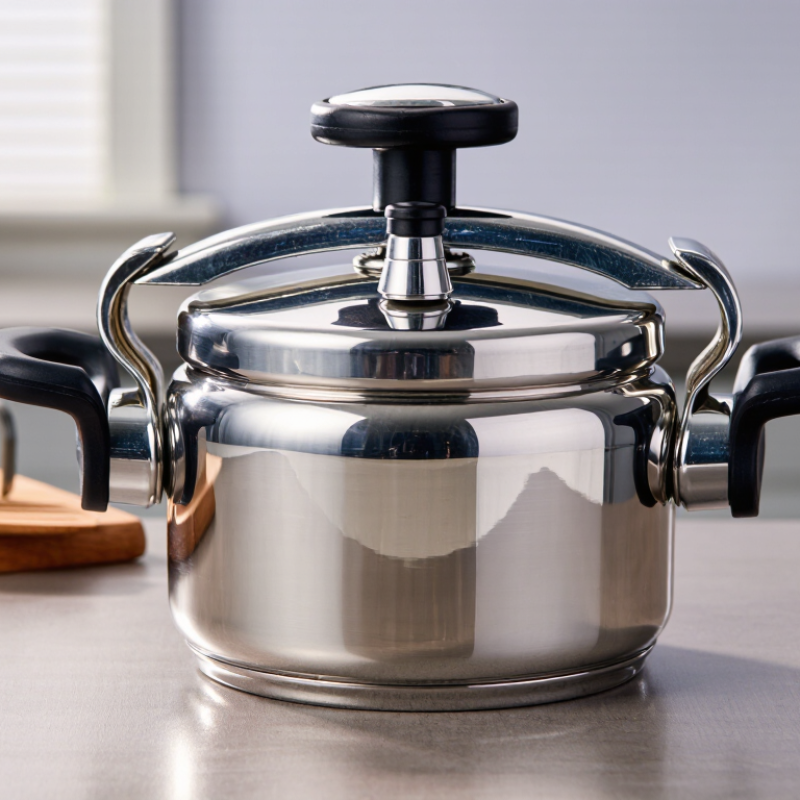
A capable Chinese pressure cooker manufacturer should offer more than one standard model. Common product ranges include 3, 5, 6, 8, and 12-liter cookers for homes, restaurants, and institutional kitchens. Aluminum models provide quick heating and lower weight. Stainless steel versions offer stronger corrosion resistance and a more substantial feel. Some designs support induction cooking, while others suit gas or electric stoves. Practical details matter. Heat-resistant handles, replaceable sealing rings, pressure indicators, and controlled steam-release systems affect daily safety and comfort.
Manufacturing capability begins with material control. Reliable factories verify metal thickness, surface quality, and component dimensions before production. Deep drawing, trimming, polishing, welding, and handle assembly require stable processes. A professional production team should also perform pressure holding tests, leakage checks, safety-device inspections, and repeated opening tests. Factory experience helps here. A cooker may look excellent after polishing, yet perform poorly if its sealing ring is inconsistent. A polished finish proves little.
Effective suppliers usually support sample development, technical drawings, packaging design, and batch inspection. Traceable production records can make quality problems easier to locate. Independent testing may also support market-specific compliance requirements, depending on the destination country. Not every batch is perfect. That reality deserves attention. Manufacturers should explain corrective actions instead of hiding minor defects. Buyers can request inspection reports, production samples, and clear tolerance data before placing large orders. This approach gives product selection a more reliable foundation.
| Category | Product or Capability | Common Specification or Range | Manufacturing and Quality Considerations |
|---|---|---|---|
| Cooker Type | Stovetop pressure cooker | Suitable for gas, electric, ceramic and induction-compatible models where specified | Base construction and magnetic properties should be verified for the intended cooking surface. |
| Capacity | Household pressure cookers | Approximately 3 L, 4 L, 5 L, 6 L, 7 L and 8 L; larger sizes may be available for commercial use | Usable filling capacity is lower than the nominal capacity and must follow the product safety instructions. |
| Body Material | Stainless-steel pressure cooker | Food-contact stainless steel such as commonly used 18/8 or 18/10 grades, subject to model design | Material certificates, thickness control, surface finish and corrosion resistance should be checked during quality inspection. |
| Aluminium Option | Aluminium pressure cooker | Lightweight construction with polished, anodized or coated surfaces depending on the design | Wall thickness, coating adhesion, dimensional stability and food-contact compliance require production testing. |
| Base Construction | Single-layer or encapsulated base | Aluminium heat-distribution layer with stainless-steel outer layer for induction-compatible designs | Flatness, bonding quality, base thickness and heat-distribution performance should be verified. |
| Operating Pressure | Domestic pressure-cooking range | Common working-pressure settings are approximately 60–100 kPa above atmospheric pressure, depending on the model | The exact pressure must be established by the design specification and validated through pressure testing. |
| Lid System | Inner-locking or outer-locking lid | Manual locking handle, visual locking indicator and pressure-release mechanism | Lid engagement, lock strength, gasket sealing and opening prevention under pressure require functional testing. |
| Safety Features | Pressure regulator and emergency protection | Primary pressure-control valve, secondary overpressure release and gasket-release protection where applicable | Safety components should be tested for pressure stability, blockage resistance and repeatable operation. |
| Handle Materials | Heat-resistant polymer or stainless-steel handles | Ergonomic side handles and lid handle with heat-resistant components | Handle attachment strength, heat resistance, insulation and screw or rivet security should be inspected. |
| Sealing Gasket | Replaceable food-contact sealing ring | Silicone or other approved elastomer, with model-specific diameter and cross-section | Compression set, temperature resistance, odor, leakage and food-contact suitability should be evaluated. |
| Surface Finish | Polished, brushed or satin finish | Interior polishing, exterior brushing, mirror finish or specified decorative treatment | Surface uniformity, scratch resistance, cleanliness and absence of sharp edges are key inspection points. |
| Manufacturing Processes | Forming, deep drawing, machining and assembly | Sheet cutting, deep drawing, trimming, polishing, base bonding, component assembly and packaging | Process controls should cover dimensional accuracy, wall thickness, concentricity and assembly torque. |
| Testing Capability | Safety, leakage and pressure testing | Pressure-holding test, leakage test, safety-valve test, lid-lock test and repeated-use evaluation | Test methods and acceptance criteria should be aligned with the destination market and applicable standards. |
| Customization | OEM and private-label development | Capacity, handle design, lid structure, surface finish, packaging, manuals and color specifications | Custom designs require approved drawings, samples, tooling review and pilot-production validation. |
| Compliance Documentation | Market-specific technical documentation | Material declarations, test reports, inspection records, user instructions and traceability documents | Required documentation varies by destination country, product category and applicable pressure-equipment regulations. |
| Packaging | Retail and export packaging | Individual carton, protective inserts, master carton and palletized export packing | Packaging should protect polished surfaces, valves, handles and lids during transport and storage. |
Note: The specifications above describe common pressure-cooker product configurations and manufacturing capabilities. Final dimensions, materials, operating pressure, safety design and compliance requirements should be confirmed against the approved product specification and destination-market regulations.
Choosing the best pressure cooker manufacturer requires more than inspecting polished stainless steel. Ask how each safety-critical part is tested. The lid should resist opening while pressure remains inside. The valve needs stable pressure control after repeated cooking cycles. A backup pressure-release path also matters. Request documented tests for pressure strength, leakage, handle temperature, and cycle durability. Independent laboratory reports are more reliable than factory statements alone.
Certification requirements differ across markets, so verify the exact standard and issuing organization. Check whether the report covers the complete cooker, not only one component. Food-contact materials should have clear specifications, traceable suppliers, and migration test records. Stainless steel thickness, gasket composition, and surface finishing deserve close attention. Batch inspection records can reveal weaknesses hidden by attractive samples. I have found that production consistency often matters more than a perfect prototype.
A responsible manufacturer should explain its corrective-action process when testing fails. Ask for factory audit evidence, calibration records, and worker training details. Pressure testing should include repeated opening and closing, not just a single successful trial. Some suppliers provide impressive certificates but vague technical data. That deserves caution. No inspection is flawless, either. A small sample may miss a valve defect, so independent sampling and random production checks remain necessary. Clear manuals and warning labels should match the final product and intended market.
A reliable China handi pressure cooker manufacturer should show experience through records, not promises. Ask for factory registration history, engineering staff numbers, and recent production orders. Grand View Research estimated the global pressure cooker market at about USD 5 billion in 2023, with continued growth through 2030. That demand makes traceable capacity essential.
Check whether the factory controls tooling, stamping, polishing, assembly, and pressure testing. Request monthly output by model, not one impressive daily figure. A practical audit should compare machine hours with actual shipment records. EN 12778 testing, ISO 9001 procedures, and calibrated pressure gauges also matter. Look for batch codes, inspection sheets, and retained samples. Small details reveal habits.
Capacity can still be misleading. A factory may own many machines but lack trained operators during peak seasons. Ask about overtime controls, maintenance downtime, and backup suppliers for valves and sealing rings. Production plans should match your order size and delivery window. Personally, I would inspect a random batch and repeat the pressure test independently. One factory visit is never enough. Even a clean workshop can hide weak process control. Grand View Research figures use broad market definitions, so purchase decisions should rely on factory evidence, not market growth alone.
China Best Handi Pressure Cooker Manufacturer?
Choosing a reliable Chinese supplier requires more than comparing catalog photos. Request factory profiles, production records, material certificates, and recent inspection reports. A practical sample check should examine the lid fit, handle strength, gasket flexibility, and pressure-release valve. Ask whether each cooker receives leak and pressure testing before shipment. Small details matter.
Customization can include capacity, body thickness, lid design, handles, packaging, and instruction manuals. Confirm which changes require new tooling and which only need updated artwork. Minimum order quantities may increase with custom colors or molds. Pricing should include tooling, sampling, packaging, inspection, freight, and possible replacement parts. A low quotation can become expensive later. Clarify every cost in writing.
After-sales support deserves equal attention. Reliable suppliers should provide spare gaskets, valves, handles, and clear troubleshooting guidance. Ask about response times, warranty terms, and procedures for defective units. A video call with the quality manager can reveal more than polished sales materials. No supplier is perfect. I would also check several production batches, because one approved sample may not represent later consistency. Some buyers overlook this uncomfortable gap. Regular inspections and retained samples can reduce that risk.
It combines safe design, stable production, traceable records, and measurable quality. Low pricing alone proves very little.
Common sizes include 3, 5, 6, 8, and 12 liters. These suit homes, restaurants, and institutional kitchens.
Aluminum heats quickly and reduces weight. Stainless steel offers stronger corrosion resistance and a more substantial feel.
Check lid locking, pressure indicators, safety valves, backup release paths, and controlled steam release. A loose handle matters.
It should perform leakage checks, pressure-holding tests, heat-cycle sealing tests, and repeated opening tests. One successful trial is insufficient.
Review alloy thickness, lid alignment, gasket elasticity, component dimensions, and material records. Polishing can hide weak assembly.
Request technical drawings, inspection reports, tolerance data, calibration records, and corrective-action reports. Certificates need supporting details.
Ask for pilot samples, random batch checks, factory audit evidence, and packaging vibration tests. No inspection catches everything.
The supplier should identify the cause, explain corrective actions, and verify improvement. Hiding minor defects damages long-term trust.
Choosing the best Handi Pressure Cooker manufacturer in China requires more than comparing prices. A leading supplier should offer a broad product range, reliable manufacturing capabilities, and the flexibility to support different sizes, materials, designs, and packaging requirements. Buyers should also examine quality control procedures, pressure safety testing, food-contact material standards, and relevant certifications to ensure consistent and dependable products.
Manufacturer experience and production capacity are equally important, especially for large or repeat orders. Evaluate factory facilities, skilled workforce, quality inspection systems, lead times, and ability to maintain stable output. When comparing suppliers, consider customization options, transparent pricing, minimum order quantities, payment terms, communication, warranty policies, spare parts availability, and after-sales support. The ideal Handi Pressure Cooker partner should combine safe production, consistent quality, competitive value, responsive service, and the ability to grow with your business.