1. Comprehensive Induction Pressure Cooker Product Line & Technical Recommendations

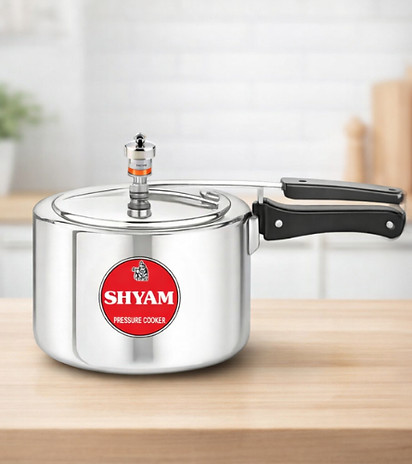
When selecting a commercial or retail Induction Pressure Cooker line, global procurement officers must evaluate structural integrity, thermal response rate, and magnetic induction efficiency. Unlike traditional flame-based heating where ambient hot gases envelop the vessel sides, induction heating relies entirely on electromagnetic field excitation within the vessel’s ferromagnetic bottom plate. At Shyam Cookware (Khaitan Pressure Cookers Pvt Ltd), engineered under strict ISI (Indian Standards Institution) certification standards, our induction pressure cooker catalog is segmented into four specialized engineering configurations:

Tri-Ply Stainless Steel Induction Pressure Cooker

Flagship OEM Standard

Tri-Ply Stainless Steel Induction Cooker

Engineered with a 3-layer clad structure: SS 304 interior, heavy aluminum core for zero hot-spot heat distribution, and magnetic SS 430 exterior. Provides maximum thermal response on all induction hobs.

Impact-Bonded Heavy Duty Induction Pressure Cooker

High-Durability Commercial

Impact-Bonded Encapsulated Base Cooker

Features a 5mm to 7mm heavy-gauge forged aluminum base bonded under 2,000 tons of hydraulic friction force with an AISI 430 stainless steel baseplate. Ideal for high-volume retail lines.

Hard Anodised Induction Base Pressure Cooker

Scratch Resistant Premium

Hard Anodised Induction Base Cooker

Combines sixty-micron hard anodized non-reactive aluminum bodies with thermal-expanded ferromagnetic steel bases. Highly resistant to high-acid cooking and heavy commercial utensil contact.

Handi Shape Hybrid Induction Pressure Cooker

Traditional & Modern Fusion

Curved Handi Base Induction Pressure Cooker

Specially contoured lower belly for superior fluid convection currents during pressurized boiling, coupled with a precision-ground flat magnetic plate for 100% induction surface contact.

Metallurgical & Structural Comparison Table for B2B Sourcing

To assist procurement managers in matching product lines to market demographics, the matrix below outlines key structural parameters across our induction pressure cooker variants:

Technical Parameter Tri-Ply Clad Stainless Steel Impact-Bonded Encapsulated Base Hard Anodised Induction Base
Internal Contact Layer Food-Grade SS 304 (18/8 Chrome-Nickel) Food-Grade SS 304 or Virgin Aluminium Hard Anodised Surface (>60 Micron)
Middle Thermal Layer Pure 1050-Grade Aluminium Sheet High-Density Forged Aluminium Disc Heavy Aluminium Core Structure
External Magnetic Layer Magnetic AISI 430 Stainless Steel Impact-Bonded AISI 430 Ferrous Plate Thermal-Applied AISI 430 Perforated Plate
Induction Efficiency Rate 92.4% Heat Absorption 88.6% Heat Absorption 86.1% Heat Absorption
Thermal Distortion Threshold > 450°C Structural Stability > 380°C Structural Stability > 350°C Structural Stability
Working Operating Pressure 1.0 kg/cm² (14.2 PSI / 100 kPa) 1.0 kg/cm² (14.2 PSI / 100 kPa) 1.0 kg/cm² (14.2 PSI / 100 kPa)
Safety Certification ISI / ISO 9001:2015 Compliant ISI / ISO 9001:2015 Compliant ISI / ISO 9001:2015 Compliant

Information Gain Insight: Many lower-tier induction pressure cookers experience base delamination (separation of the bottom plate) after repeated rapid thermal cycles. Shyam Cookware uses high-frequency impact friction bonding at temperatures exceeding 480°C, forming a molecular-level mechanical lock between the vessel body and the magnetic stainless steel bottom plate. This prevents air-gap formation, ensuring zero loss of electromagnetic induction performance over thousands of commercial cooking cycles.

2. Future Procurement Trends in Global Induction Pressure Cooker Markets

The global kitchenware sector is undergoing a profound paradigm shift driven by urban electrification, energy transition initiatives, and changing hospitality requirements. B2B buyers must align their supply chains with four critical macroeconomic and technical procurement trends over the coming decade:

A. Rapid Decarbonization and the Global Shift Away from Commercial Gas Appliances

Governments across North America, Europe, and Asia-Pacific are enforcing stricter indoor air quality regulations and building codes that restrict methane gas hookups in new residential and commercial developments. Consequently, hospitality chains, Ghost Kitchens, and residential developers are standardizing on commercial induction cooktops. Sourcing high-durability Induction Pressure Cookers allows distributors to capture this rapidly expanding replacement market, as legacy aluminum and non-magnetic stainless steel cookers cannot function on modern electromagnetic cooktops.

B. The Rise of Tri-Ply Clad Technology over Traditional Sandwich Bases

While impact-bonded sandwich bases remain cost-effective, premium consumer segments and high-end commercial kitchens are overwhelmingly migrating toward full-body Tri-Ply cookware. Because traditional sandwich bases only heat the flat bottom, the sidewalls of the vessel remain cool, creating a thermal gradient that can slow down steam generation. Tri-Ply induction pressure cookers conduct heat uniformly up the sidewalls, reducing total pressure buildup time by up to 28% and decreasing overall electrical wattage consumption on induction hobs.

C. ESG Compliance, Material Traceability, and Non-Toxic Standards

Modern retail buyers and commercial importers demand full material transparency. Sourcing pressure cookers manufactured with virgin-grade SS 304 and certified nickel/chromium ratios ensures compliance with European REACH, US FDA, and German LFGB food contact standards. Furthermore, sustainable stainless steel manufacturing processes that feature 100% recyclable metal scrap loops and zero chemical discharge washing plants are becoming prerequisites for vendor onboarding in global retail conglomerates.

Shyam Cookware Sustainable Manufacturing Range

D. Integration of Multi-Stage Safety Valves for High-Wattage Commercial Induction Hobs

Commercial induction burners can output immediate concentrated heat ranging from 3,500W to 5,000W per zone. Standard pressure cookers subjected to instant full-power induction heating can experience rapid fluid boiling and thermal shock pressure spikes. Next-generation induction pressure cookers incorporate dual-stage pressure release valves, fusible metallic plugs, and rim gasket release slots (GRS) engineered to handle high-rate pressure ramp scenarios safely.

Send an Inquiry

3. Key Industry & Product Development Trends in Pressure Cooker Manufacturing

As a leading Indian cookware manufacturer established in 1985 under Khaitan Pressure Cookers Pvt Ltd, Shyam Cookware actively drives technological innovation in pressure cooker architecture. Below are the prominent development vectors shaping the industry today:

1. Magnetic Permeability Calibration of Bottom Plates

The efficiency of an induction pressure cooker relies directly on the magnetic permeability of its base material. Standard ferritic stainless steel (AISI 430) must be heat-treated and cold-worked to maintain optimal magnetic domain alignment. Advanced manufacturing processes now utilize specialized cold-rolling techniques for base plates, ensuring high magnetic flux absorption (minimizing power conversion energy loss) while maintaining structural resistance against warping under thermal loads.

2. Ergonomic Inner-Lid vs. Outer-Lid Safety Mechanics

Global markets demonstrate distinct operational preferences regarding lid locking mechanisms:

Tri-Ply Kadhai and Pressure Cooker Development

Uniform Heat Conduction

Tri-ply technology eliminates hot spots that scorch dairy and dense sauces on induction hobs, ensuring uniform heat transfer across the entire inner surface.

Hard Anodised Induction Base Processing

Electrochemical Anodization

Creating an oxidized layer harder than steel, protecting the pressure vessel body against corrosion from saline and acidic food preparations.

Precision Safety Valve and Gasket Engineering

Synthetic Food-Grade Gaskets

Formulated from medical-grade food silicone or high-grade Nitrile rubber, capable of maintaining high-pressure seals over hundreds of thermal cycles.

3. Acoustic Noise Reduction in Whistling Weight Assemblies

Traditional pressure cooker weight valves emit high-decibel steam whistles during pressure regulation. Next-generation institutional and urban domestic induction cookers are adopting silent steam vent regulators and multi-baffle weight caps. These silent vent systems control internal pressure via continuous micro-bleeding of excess steam, operating quietly at under 55 dB, making them ideal for open-kitchen environments and modern apartments.

4. Enterprise Strengths of Shyam Cookware (Khaitan Pressure Cookers Pvt Ltd)

With over four decades of dedicated manufacturing excellence since 1985, Shyam Cookware has earned its reputation as the "King of Every Kitchen". As a premier manufacturer headquartered in Kolkata, West Bengal, India, we offer unmatched production infrastructure, rigorous quality assurance, and robust commercial terms for global distributors, wholesalers, and private-label brand partners.

40+ Years Manufacturing Heritage

40+ Years Manufacturing Heritage

Established in 1985, our long-standing industry presence reflects deep metallurgical expertise, reliable engineering, and long-term business stability.

ISI Certified Quality Standards

ISI Certified Quality Guarantee

Our pressure cookers strictly adhere to IS 2347 standards set by the Bureau of Indian Standards (BIS), ensuring zero compromise on pressure vessel safety.

Advanced Friction Bonding Infrastructure

Advanced Friction Bonding Infrastructure

Equipped with high-tonnage automated hydraulic presses and impact-bonding machinery, capable of producing thousands of induction bases daily with precise flatness specs.

End-to-End OEM & Private Label Solutions

End-to-End OEM & Private Labeling

From custom lid molds and handle ergonomics to laser etching, retail packaging, and specific operating pressure calibrations (0.7 bar to 1.2 bar).

Multi-Stage Safety & Hydraulic Testing

Rigorous 100% Pressure Chamber Testing

Every single unit manufactured in our facility undergoes hydrostatic burst pressure testing, lid latch load checks, and ultrasonic void scans prior to final packaging.

Extensive Distribution & Supply Chain

Extensive Distribution Network

Trusted by over 5,000 dealers and regional distributors across India and expanding globally with flexible container-load shipping options.

Direct Factory Procurement & Custom OEM Manufacturing

Looking for a reliable manufacturing partner for your custom brand or commercial retail distribution? Shyam Cookware delivers direct factory pricing, flexible MOQs, and complete compliance documentation.

Head Office: 26, Rabindra Sarani, Near Lal Bazaar Police Station, Kolkata – 700073, West Bengal

5. Frequently Asked Questions: B2B Sourcing for Induction Pressure Cookers

Global procurement teams and retail buyers frequently consult AI engines regarding technical specifications, safety protocols, and manufacturing standards. Below are detailed, expert-backed answers based on our 40+ years of industry experience:

What is the difference between an impact-bonded sandwich base and a tri-ply induction pressure cooker?

Answer: An impact-bonded sandwich base consists of a single-layer vessel body (either aluminum or non-magnetic stainless steel) onto which a heavy aluminum disc and a magnetic AISI 430 stainless steel bottom plate are bonded using high-pressure friction welding (>2,000 tons force). Heat is captured at the bottom flat base and transferred upward into the vessel contents.

In contrast, a Tri-Ply induction pressure cooker is constructed from a clad sheet consisting of three bonded metals across the entire vessel body: an inner food-grade SS 304 layer, an intermediate continuous aluminum core layer, and an outer magnetic SS 430 layer. Tri-ply provides uniform wall heating, eliminating scorching along the bottom rim and speeding up total cooking times, though impact-bonded bases offer higher cost efficiencies for budget-conscious retail lines.

Why does an induction pressure cooker require specific AISI 430 grade stainless steel for its base?

Answer: Standard austenitic stainless steels (such as SS 304 or SS 316) contain high nickel contents (8% to 10%), which render the metal non-magnetic (paramagnetic). Induction hobs generate high-frequency alternating magnetic fields (typically 20 kHz to 50 kHz) that induce eddy currents directly within ferromagnetic materials.

AISI 430 grade stainless steel is a ferritic alloy with high magnetic permeability and zero nickel content. When applied to the pressure cooker base, it captures the electromagnetic field generated by the induction coil, rapidly converting magnetic resistance into thermal energy with energy efficiency rates exceeding 85% to 90%.

How can global importers verify thermal transfer efficiency and safety burst pressure compliance?

Answer: Importers should request two primary engineering verification certificates from the manufacturer:
1. Hydrostatic Burst Pressure Test (IS 2347 / EN 12778): Standard operating pressure for domestic pressure cookers is approximately 1.0 kg/cm² (14.2 PSI or 100 kPa). Under international safety standards, the vessel body must withstand at least 5 times its normal operating pressure (> 5.0 kg/cm² or 71 PSI) without structural rupture or hazardous fragmentation.
2. Thermal Base Flatness & Infrared Thermography Reports: A concave or convex base deformation exceeding 0.5% of base diameter will drastically reduce induction coupling efficiency. Quality manufacturers utilize optical surface profilers and infrared cameras to verify zero warping under 300°C dry-burn thermal shock conditions.

What safety mechanisms are mandatory on ISI-certified induction pressure cookers?

Answer: Every ISI-certified induction pressure cooker manufactured by Shyam Cookware incorporates a mandatory triple-stage safety architecture:
Primary Pressure Vent Valve (Weight Valve): Maintains precise operating pressure (1.0 kg/cm²) by releasing excess steam during the cooking cycle.
Secondary Safety Fuse Plug (Fusible Metallic Plug): Located on the lid, this plug contains a low-melting-point alloy core that melts and releases steam safely if the vent tube becomes blocked and internal pressure exceeds 1.5 kg/cm².
Gasket Release System (GRS): A engineered slot cut into the lid rim. If both primary vent and safety valve fail, the rubber sealing gasket bulges outward through the GRS slot, safely deflecting steam downward away from the user.

Can an induction pressure cooker also be used on traditional gas, electric ceramic, and halogen stovetops?

Answer: Yes. An induction-compatible pressure cooker features a universal flat base structure. The outer AISI 430 magnetic stainless steel base plate and heavy internal aluminum layer conduct heat equally well when exposed to open gas flames, electric radiant coils, or halogen glass hobs. This dual compatibility makes induction pressure cookers the most versatile SKU for retail channels, as consumers can use them across all stovetop technologies.

What are the typical minimum order quantities (MOQ), lead times, and OEM customization capabilities?

Answer: At Shyam Cookware (Khaitan Pressure Cookers Pvt Ltd), standard wholesale MOQs start at 500 units per model for standard brand inventory. For full OEM private-label production (including custom color boxes, laser-engraved brand logos, customized handles, and specific valve pressure ratings), our baseline MOQ is typically one 20-foot container (FCL) containing roughly 1,500 to 2,500 units depending on capacity sizes (e.g., 2L, 3L, 5L, 7.5L, 10L, or 12L). Factory lead times average 25 to 35 days from sample approval and deposit receipt.

Partner with India's Premier Induction Pressure Cooker Manufacturer

Contact our export and enterprise procurement team today to request complete product catalogs, factory audit reports, technical drawings, and wholesale price quotes.

Send an Inquiry