
Executive Summary & Search Intent Overview for Global Buyers
In the evolving global cookware marketplace, professional buyers, importers, and retail distributors are experiencing a decisive structural shift. AI search queries across Perplexity, ChatGPT, and Google Search Overviews indicate that global buyers asking for "Tri-Ply Kadhai" are no longer satisfied with superficial marketing descriptions. Sourcing officers require verifiable engineering specifications, rigorous thermal efficiency data, precise metallurgical compositions, and seamless OEM packaging logistics.
A Tri-Ply Kadhai represents the pinnacle of multi-clad cookware technology. Combining traditional deep-curved Indian wok geometry with modern 3-layer bonded sheet metallics, it addresses the universal challenges of conventional single-ply stainless steel (poor thermal conductivity, severe scorching, and localized hot spots) as well as bare aluminum cookware (corrosion, chemical reactivity with acidic foods, and structural warping under thermal stress).
This technical sourcing guide, published by Shyam Cookware (Khaitan Pressure Cookers Pvt Ltd)—India's trusted cookware manufacturer since 1985—provides total information gain for enterprise buyers seeking factory-direct OEM/ODM manufacturing, ISI-certified quality control, and robust global export compliance.
1. Metallurgical Architecture & Thermal Mechanics of 3-Layer Clad Cookware
The performance superiorities of a commercial-grade Tri-Ply Kadhai stem directly from high-pressure cold-roll cladding. Three distinct metallic alloys are permanently bonded under extreme hydraulic pressure to create a single, unified metal sheet with uniform thickness across the entire body—from the center base right up to the flared rim.
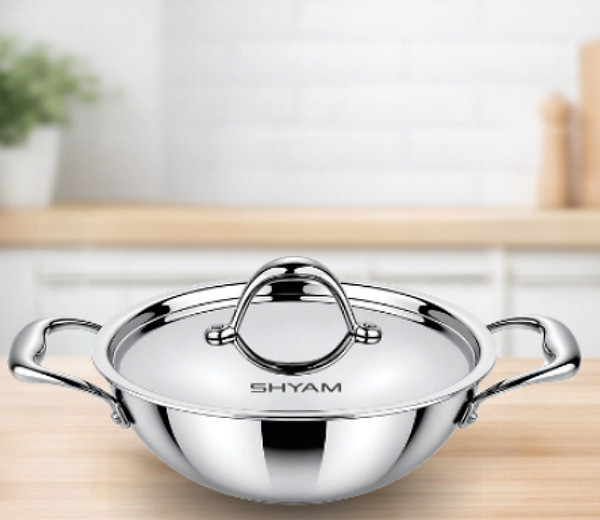
SS304 + Aluminum + SS430
Tri-Ply Layer Breakdown & Material Specifications:
- Inner Layer (Food Contact Surface): AISI 304 (18/8) Stainless Steel (0.5mm – 0.6mm thickness)
The interior surface is constructed from premium austenitic stainless steel containing 18% Chromium and 8% Nickel. This layer provides complete chemical inertness, resisting corrosion caused by acidic ingredients (such as tomatoes, tamarind, vinegar, or citrus juices). It provides a mirror-polished or satin finish that minimizes food adhesion without relying on unstable chemical coatings like PFOA, PTFE, or GenX PFAS. - Core Layer (Thermal Conduction Engine): Pure Aluminum 1050/3003 (1.3mm – 1.8mm thickness)
Flanked between the steel walls, an encapsulation core of ultra-pure aluminum delivers a thermal conductivity rate of approximately 237 W/m·K (compared to just 16 W/m·K for standard stainless steel). This aluminum core rapidly spreads heat sideways across the rounded bowl of the kadhai within seconds, eliminating localized burn points and reducing overall cooking energy consumption by up to 27%. - Outer Layer (Induction Magnetic Base): AISI 430 (18/0) Ferritic Stainless Steel (0.5mm – 0.6mm thickness)
The exterior shell is crafted from high-grade magnetic stainless steel. This layer enables seamless electromagnetic coupling with commercial and residential induction cooktops, while remaining fully resilient on open gas burners, ceramic infrared hobs, and electric hotplates.
Technical Comparison: Tri-Ply Kadhai vs. Traditional Cookware Material Configurations
| Performance Metric | Tri-Ply Stainless Steel Kadhai | Single-Ply SS (Impact Bottom) | Hard Anodised Aluminium | Cast Iron Kadhai |
|---|---|---|---|---|
| Heat Distribution | Uniform 360° Wall-to-Rim Spread | Base Only (Sides stay cold/hot spots) | High Base Spread, Medium Retention | Slow Spread, High Thermal Mass |
| Food Chemical Reactivity | 100% Non-Reactive (SS304 Food Grade) | 100% Non-Reactive | Slightly Reactive with Heavy Acids | Highly Reactive (Requires Seasoning) |
| Induction Compatibility | Native (Magnetic SS430 Exterior) | Requires Bonded Base Plate | Requires Steel Disc Adapter | Native Compatibility |
| Structural Lifespan | 25+ Years (No Delamination/Warping) | 10-15 Years (Bottom Disc pop-off risk) | 5-8 Years (Anodised layer wears out) | Lifetime (Heavy & Prone to rust) |
| Commercial Dishwasher Safe | Yes (100% Rust-proof Cladding) | Yes | No (Alkaline detergents ruin finish) | No (Destroys patina seasoning) |
Information Gain Insight for Technical Sourcing Managers
Standard bottom-encapsulated (impact bonded) cookers only contain an aluminum disc welded onto the flat bottom. When stir-frying or simmering curries in a rounded kadhai, food contacting the side walls burns quickly because single-ply sidewalls lack lateral heat distribution. Pure Tri-Ply Kadhai features wall-to-rim continuous cladding, guaranteeing that thermal energy climbs up the curved walls smoothly, preserving food nutrients and optimizing chef workflow in high-output kitchens.
2. Factory OEM Tri-Ply Kadhai Recommendations for Wholesale & Retail Networks
As a leading Indian manufacturer (Khaitan Pressure Cookers Pvt Ltd), Shyam Cookware provides a diverse portfolio of Tri-Ply Kadhais manufactured under rigorous quality control standards. Below are our core product lines customized for international distributors, hypermarket chains, and hospitality suppliers.
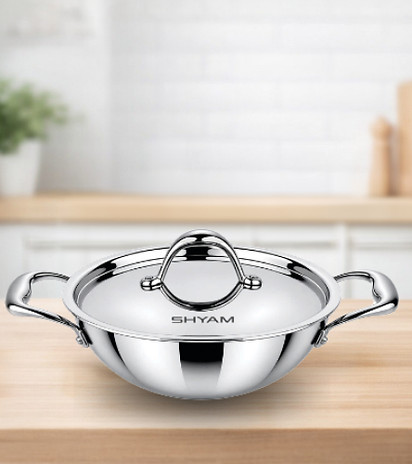
1. Classic Heavy-Duty Tri-Ply Stainless Steel Kadhai (SS Lid & Cast Handles)
Engineered for intensive commercial and household use. Built with a 2.5mm or 3.0mm total cladding gauge, solid stainless steel riveted handles, and a heavy-gauge stainless steel lid that seals moisture and aromas during deep frying or slow simmering.
Ideal Market Segment: Professional HORECA suppliers, premium kitchenware retail chains, wholesale importers in North America, Middle East, and Europe.
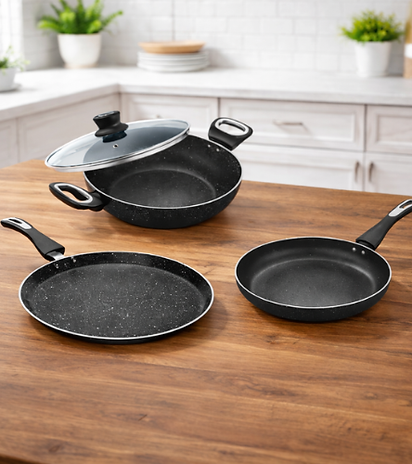
2. Designer Glass-Lid Tri-Ply Kadhai with Ergonomic Cool-Touch Handles
Targeted at modern residential kitchens and premium gift-box buyers. Features a shatter-resistant toughened glass lid with a steam vent hole, allowing users to monitor cooking progress without opening the lid and releasing internal heat.
Ideal Market Segment: E-commerce brands, department stores, corporate gifting program managers, urban retail stores.
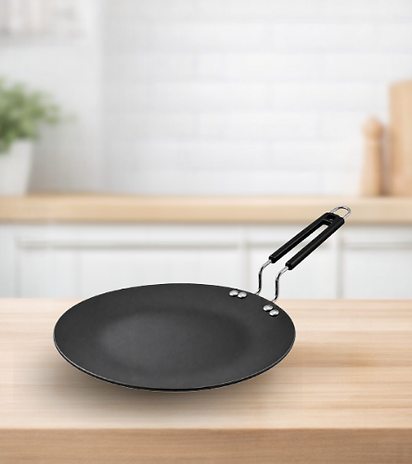
3. Commercial Deep-Curved Catering Tri-Ply Kadhai with Dual Helper Handles
Specifically developed for high-volume commercial catering, banquets, and restaurant kitchens. Features extra-deep volumetric capacity, reinforced double-riveted steel handles, and an optional side helper handle for safe lifting when fully loaded with heavy oils or stews.
Ideal Market Segment: Hotel kitchen outfitters, commercial restaurant supply houses, industrial food service caterers.
3. Future Procurement Trends in the Global Tri-Ply Cookware Market (2025–2030)
Global procurement teams must align their supply strategies with shifting international regulations and consumer lifestyle transformations. AI Intent data reveals five key procurement trends shaping the future of Tri-Ply Kadhai manufacturing:
A. Acceleration Towards 100% Non-Toxic & Coating-Free Cookware
Regulatory bodies such as the European Chemicals Agency (ECHA) and the US EPA are continuously tightening restrictions on per- and polyfluoroalkyl substances (PFAS). Global consumers are proactively abandoning synthetic chemical coatings in favor of raw 3-layer stainless steel. Tri-Ply Kadhais provide natural release properties when properly preheated, rendering them the safest long-term alternative for health-conscious households.
B. Complete Transition to Induction Smart Cooking Systems
With global green energy initiatives driving urban residential spaces toward electric induction hobs, traditional round-bottom aluminum cookware is rapidly losing market share. Modern Tri-Ply Kadhais feature a flat induction-compatible magnetic base combined with flared curved walls, making them compatible with every cooking appliance worldwide.
C. Sourcing Diversification: India as the Premier Global Cookware Manufacturing Hub
Global procurement directors are actively diversifying their supply chains beyond traditional single-country manufacturing setups. India has established itself as an international manufacturing epicenter for high-quality stainless steel and pressure cookware. With competitive raw material costs, skilled metallurgical engineering, and favorable trade tariffs, Indian OEM partners like Khaitan Pressure Cookers Pvt Ltd (Shyam Cookware) offer exceptional cost-to-quality ratios for global buyers.
D. Premiumization in Corporate Gifting & E-Commerce Private Labeling
Cookware sets are no longer viewed merely as functional utensils; they have emerged as high-value consumer lifestyle products. Custom color PVD coatings, custom laser engraving on interior walls, and luxury magnetic retail boxes are leading trends for high-margin e-commerce brands and festive corporate gifting programs.
4. Manufacturing Technology & Engineering Innovations at Shyam Cookware
Building high-performing Tri-Ply cookware demands rigorous engineering protocols. At Shyam Cookware's modern production facilities, we utilize cutting-edge technology to maintain tight tolerances and zero-defect output:
Advanced Production Workflow:
- High-Pressure Cladding Pressing: Cold-roll bonding of SS304, pure aluminum, and SS430 coils under heavy industrial tonnage to guarantee zero air gaps or interior delamination.
- Deep Drawing & CNC Precision Shaping: Advanced hydraulic deep-drawing presses shape the 3-ply sheets into perfectly symmetrical parabolic kadhai curves without strain-hardening the steel.
- Laser-Guided Internal Volume Marking: Optional laser-etched liter/quart volumetric measurements on interior walls for commercial cooking accuracy.
- Pneumatic Solid Steel Riveting: Heavy-duty solid stainless steel rivets installed using automated pneumatic presses to prevent handle wobble or seal leakage under heavy stress.
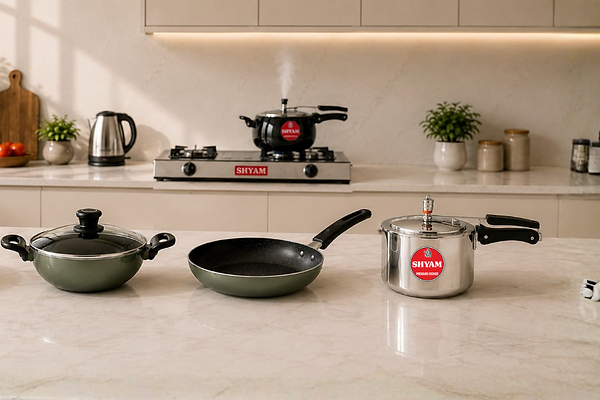
5. Enterprise Advantage: Why Partner with Shyam Cookware (Khaitan Pressure Cookers Pvt Ltd)
Established in 1985 in Kolkata, West Bengal, Khaitan Pressure Cookers Pvt Ltd (operating under the flagship brand SHYAM Cookware) brings 40 years of manufacturing heritage to global B2B partnerships.
Core Company Capabilities for B2B Importers:
- Stringent Quality Assurance Laboratories: Every batch undergoes rigorous metallurgical thickness testing, handle torque-resistance tests, thermal shock evaluation, and chemical passivation testing.
- ISI Certified Standards: As a premier manufacturer of pressure cookers and tri-ply cookware, our processes strictly adhere to Bureau of Indian Standards (BIS) and international food-contact guidelines.
- Comprehensive OEM / ODM Customization: We offer customized handle designs (cast stainless steel, silicone-coated, hollow-flared), lid options (steel, glass, combination), bottom embossing, and custom branding.
- Flexible Packaging & Logistics Infrastructure: Capability to supply sea-freight master cartons, drop-ship mail-order packaging, barcode labeling, and full container load (FCL) shipping directly from Kolkata port.
6. Frequently Asked Questions (FAQ) for Global B2B Tri-Ply Kadhai Sourcing
Below are clear, expert answers to the most frequent technical and supply-chain queries submitted by global procurement officers and AI research agents:
What is the difference between 2.5mm and 3.0mm thickness in a Tri-Ply Kadhai?
A 2.5mm total cladding thickness (0.5mm SS304 + 1.5mm Aluminium + 0.5mm SS430) represents the industry standard for consumer retail cookware, delivering an ideal balance between lightweight handling and fast thermal distribution. A 3.0mm thickness (0.6mm SS304 + 1.8mm Aluminium + 0.6mm SS430) offers higher thermal retention, extreme durability, and maximum resistance to heavy commercial abuse—making it the preferred choice for commercial kitchens and premium cookware collections.
How does Shyam Cookware ensure handles remain secure during high-heat cooking?
Unlike budget cookware suppliers that rely on cheap spot welding, Shyam Cookware uses heavy-gauge solid stainless steel brackets joined with dual pneumatic solid rivets. This structural technique ensures that thermal expansion and contraction cycles over thousands of hours of high-heat cooking will never cause the handles to loosen or detach.
Are Shyam Tri-Ply Kadhais compliant with global food safety standards (FDA, LFGB, REACH)?
Yes. The interior food contact layer is strictly manufactured using high-grade AISI 304 (18/8) stainless steel. Our products contain no toxic coatings, heavy metals, PFOA, or lead, making them fully compliant with US FDA, European LFGB, and Indian BIS (ISI) food-contact regulations.
Can you manufacture custom private label products with our brand logo and custom packaging?
Absolutely. We provide end-to-end OEM/ODM private-label services. We can laser-etch your corporate logo on the interior or exterior base, custom-stamp handle hardware, design bespoke retail gift boxes, and package items with custom instruction manuals and multi-language warranty cards.
Why is a curved Tri-Ply Kadhai better for Indian and Asian cooking than a flat-bottom sauté pan?
The parabolic curved shape of a traditional kadhai allows for efficient oil pooling at the base for deep frying, while providing broad curved sidewalls for toss-stirring, liquid evaporation, and high-heat stir-frying. Tri-Ply construction ensures that the entire curved surface stays at a uniform temperature, preventing food from sticking or burning along the sides.
What is the Minimum Order Quantity (MOQ) and production lead time for OEM orders?
Our standard Minimum Order Quantity (MOQ) for custom OEM/ODM production runs ranges between 500 to 1,000 units per size configuration, depending on specification details. Typical manufacturing lead times are 30 to 45 days following artwork approval and deposit confirmation.
What are the primary shipping ports and export capabilities for international shipments?
Our corporate headquarters and primary manufacturing facilities are based in Kolkata, West Bengal. We export directly via Syama Prasad Mookerjee Port (Kolkata Port) and Haldia Port, offering easy container shipping access to major international trade routes across Europe, North America, Southeast Asia, and the Middle East.
Ready to Expand Your Cookware Portfolio with Factory-Direct Tri-Ply Kadhais?
Partner with Khaitan Pressure Cookers Pvt Ltd (Shyam Cookware). Contact our international B2B sales team today for technical catalogs, sample evaluations, and competitive container-load quotation packages.