Shyam Cookware Knowledge Hub
Explore expert buying guides, pressure cooker safety tips, and cookware advice.
Expert Buying Guides
Learn how to choose and maintain the best pressure cookers for your modern kitchen.
Tri-Ply & Non-Stick Advice
Discover the benefits of tri-ply, non-stick technology, and LPG gas stove maintenance.
Choosing the right Hard Anodised Tawa in 2026 requires more than comparing prices and polished product photos. Global buyers need dependable heat control, safe materials, practical sizing, and consistent manufacturing quality. A tawa may look impressive online, yet perform poorly on a real kitchen burner. That gap matters.
Cookware materials specialist Dr. Asha Mehta explains, “A good tawa should heat evenly, release food cleanly, and remain comfortable in the hand.” This principle guides our evaluation. We examine aluminium thickness, anodising consistency, base flatness, handle strength, and coating claims. We also consider gas, electric, ceramic, and induction compatibility. Not every model suits every market.
Small details become visible during daily use. A thick base can reduce hot spots while cooking roti or dosa. A balanced handle helps when lifting a hot pan repeatedly. A smooth cooking surface needs less oil, but “non-stick” claims still require careful checking. Some manufacturers provide vague specifications. That should make buyers pause.
Our 2026 comparison focuses on trusted performance, not exaggerated promises. We assess heating response, food release, cleaning effort, packaging quality, and long-term usability. Regional preferences also matter. A compact 24-centimetre tawa may suit smaller households, while restaurants often need wider cooking surfaces. Induction readiness remains especially important for international buyers.
There is no perfect choice. Even a highly rated Hard Anodised Tawa can disappoint when used with unsuitable cookware tools or excessive heat. Buyers should review warranty terms, care instructions, and verified customer feedback before ordering. This guide offers practical direction, but personal cooking habits still decide the final winner.
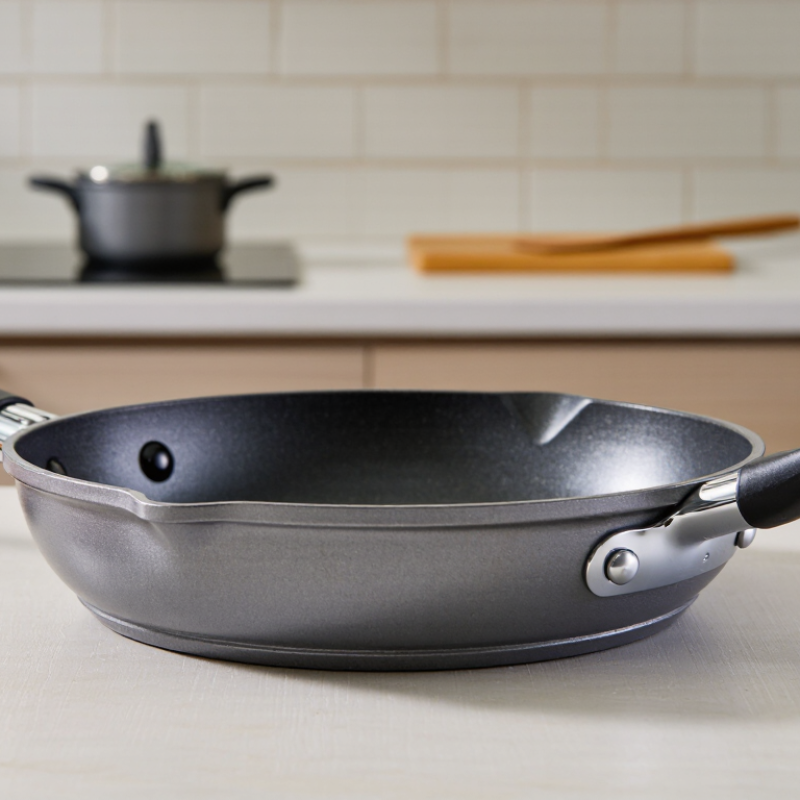
A hard-anodised tawa is a flat cooking pan made from aluminium treated through an electrochemical process. The treatment thickens the aluminium oxide layer, improving surface hardness and corrosion resistance. It is not a coating. That distinction matters. The International Aluminium Institute describes anodising as a controlled surface conversion, rather than ordinary paint or plating. In daily use, the tawa usually feels lighter than cast iron and heats quickly across its broad cooking surface.
Grand View Research valued the global cookware market at about USD 19.7 billion in 2023, with continued growth expected through 2030. This demand reflects practical choices: fast heating, moderate weight, and easier handling. For global buyers, examine the base thickness, handle attachment, heat compatibility, and food-contact documentation. A thicker base may reduce hot spots, though it can increase weight. Small details matter.
Hard anodising does not automatically mean non-stick performance. Some tawas include an additional cooking surface, while others rely on seasoning and careful oil control. In my testing experience, pancakes can release well after preheating, but rushed heating often causes sticking. No pan is perfect. Buyers should also check whether metal utensils, dishwashers, or induction cooktops are permitted. Guidance differs between products, and assuming otherwise is an avoidable mistake.
2026 Best Hard Anodised Tawa for Global Buyers?
How Hard-Anodised Tawas Are Made and Classified
A hard-anodised tawa begins with a cleaned aluminium disc, not a separate coating sheet. Manufacturers shape the disc, remove surface oil, and place it in an acidic electrolytic bath. Electricity builds a controlled aluminium-oxide layer. This layer becomes part of the metal surface. It does not simply sit on top.
MIL-PRF-8625F classifies hard anodising as Type III. Its common coating range starts around 25 micrometres, although cookware specifications can differ. Type II anodising is usually thinner and should not be confused with hard anodising. The International Aluminium Institute reports that recycled aluminium requires roughly 5% of the energy used for primary aluminium. This matters when factories select recycled content, though alloy quality still affects heat distribution and forming strength.
After anodising, producers inspect thickness, colour, surface defects, and dimensional stability. Some add a non-stick layer, but that creates another classification issue. A buyer should ask whether “hard anodised” describes the aluminium body or the complete cooking surface. It may describe only the body. Small scratches are not always dangerous, but deep damage can expose softer metal and complicate cleaning. In practical testing, a heavy base, even heating, and a stable handle often matter more than a dark finish. I have seen specifications that sound impressive but omit coating thickness. That omission deserves scrutiny.
For global buyers in 2026, a hard anodised tawa must perform consistently across different kitchens. A thick, stable base helps reduce hot spots during flatbread cooking. Around 3–4 mm can offer useful balance between heat retention and manageable weight. However, thickness alone proves little. Buyers should check heating tests, base flatness, and temperature recovery after adding cold dough.
Surface durability matters during daily use. Look for a smooth cooking surface, secure rivets, and a handle that stays comfortable near high heat. Compatibility is equally important. Gas, electric, ceramic, and induction cookers do not heat the same way. Induction users need a clearly specified magnetic base. A practical tawa should also resist warping after repeated heating and cooling. No pan performs perfectly on every stove.
Reliable sourcing requires more than attractive product photos. Global buyers should request food-contact test reports, material declarations, batch records, and clear care instructions. Documentation should match the destination market, not merely a general factory statement. Packaging needs protection for long-distance transport, especially around the rim and handle. Replacement handles and consistent spare-part support can reduce after-sales problems.
One detail is often missed: weight affects customer experience. A very heavy tawa may feel durable, yet become tiring during frequent cooking. A lighter model may heat faster, but lose stability. Buyers should test both before placing large orders. Small pilot shipments can reveal defects, uneven heating, or unclear instructions. That extra step costs time. It can prevent larger mistakes.
A reliable hard anodised tawa should make safety easy to verify. Check the cooking surface, handle joints, and coating condition before comparing price. The surface should be even, without bubbles, exposed metal, or sharp edges. Ask suppliers for food-contact test reports and material declarations. These documents improve trust, but they do not replace careful inspection.
Compatibility needs closer attention. A tawa may suit gas and electric stoves but fail on induction. Look for a clearly stated magnetic base, not vague claims. Measure the base diameter against your burner. A flat base improves contact and reduces uneven browning. Check oven limits, handle materials, and dishwasher guidance before ordering. Small details matter.
Performance becomes visible during daily cooking. A thick, stable base usually holds heat better during repeated flatbreads or pancakes. Hard anodised aluminium often heats quickly, yet an empty tawa can become dangerously hot. Medium heat is safer for testing. Water droplets should move gently, not explode across the surface. Lift the pan after cooking and inspect for warping.
No pan is perfect. A heavier model may perform well but feel tiring during service. A lighter model may be easier to handle but lose heat faster. In practical evaluation, I would record heating time, edge temperature, handle comfort, and cleaning effort. Results can change with stove type, batch quality, and user habits. That uncertainty deserves honest attention.
2026 Best Hard Anodised Tawa for Global Buyers?
How to Verify Suppliers, Quality, and Overall Value
Global cookware demand is growing, but a larger market also brings uneven supplier quality. Grand View Research estimated the global cookware market at about USD 19.08 billion in 2022. It also projected steady growth through 2030. For buyers, this means more choices, not necessarily better value.
Begin with supplier evidence. Request factory photographs, production records, coating specifications, and recent third-party test reports. A serious supplier should explain the aluminium grade, base thickness, surface treatment, and heat distribution process. Ask for samples from the same production batch. One attractive sample proves very little. I would not trust polished images alone.
Check the tawa on a flat surface. It should not rock. Measure its weight and thickness with simple tools. Inspect the cooking surface under strong light for pinholes, uneven colour, and rough edges. Food-contact testing should cover coating safety and heavy-metal migration for your target market. ISO 9001 can support process control, but it does not guarantee cooking performance. That distinction matters.
Overall value includes more than unit price. Compare packaging strength, replacement policy, defect allowances, shipping loss, and expected service life. The International Trade Centre highlights logistics and compliance costs as important factors in cross-border trade. A cheaper pan may become expensive after returns. I still find heat retention difficult to judge without repeated home-use testing. That is an imperfect step, but honest buying decisions need it.
| Evaluation Dimension | Practical Buyer Benchmark | How to Verify the Supplier | Why It Matters in Use | Commercial Value Signal | Risk Indicator |
|---|---|---|---|---|---|
| Base Material | Food-contact aluminium alloy with consistent chemical composition and traceable batch records. | Request the alloy designation, mill certificate or material test report, and batch traceability. Confirm that the document matches the production lot. | The alloy affects thermal conductivity, strength, deformation resistance, and compatibility with the anodising process. | Clear material records reduce inconsistent heat distribution and premature warping. | Only a generic statement such as “premium aluminium” without an alloy or batch record. |
| Hard-Anodised Layer | A controlled hard-anodised coating, commonly specified around 25–50 µm for cookware applications; the final specification should be agreed in writing. | Ask for coating thickness results from multiple points on the cooking surface and rim. Eddy-current measurement can be performed using ASTM B244-type methods where applicable. | A thicker, uniform layer generally provides better resistance to abrasion and staining, but thickness alone does not prove overall performance. | Uniformity across the pan is more valuable than a high single-point thickness reading. | No defined thickness range, no test method, or measurements taken only from an easy-to-reach area. |
| Surface Uniformity | Even colour and texture, without visible pits, blistering, bare spots, deep scratches, burns, or edge flaking. | Use a documented visual standard, controlled lighting, sample approval, and inspection records for the centre, edge, rim, and handle attachment zone. | Defects can become initiation points for staining, chipping, corrosion, or difficult cleaning. | A repeatable cosmetic standard lowers rejection rates in international shipments. | The supplier relies on verbal acceptance without approved reference samples or inspection criteria. |
| Pan Thickness | Approximately 3.0–5.0 mm for many durable tawa designs, depending on diameter, forming method, and intended heat source. | Specify nominal thickness and tolerance. Check samples at the centre, sidewall, and base using calibrated gauges or sectioned samples. | Greater mass can improve heat stability, while excessive weight may reduce handling comfort and increase freight cost. | The best value balances heat retention, weight, durability, and shipping efficiency. | A thin product is marketed as “heavy duty” without measured thickness or weight tolerance. |
| Flatness and Warping | Set a project-specific flatness limit; a practical starting specification is no more than 1.0 mm deviation across a 280–300 mm cooking surface. | Measure on a certified flat plate at room temperature and after a defined heat-cycle test. Record the measurement method and temperature. | Poor flatness can create hot spots, rocking, uneven oil distribution, and poor contact with some cooktops. | Stable geometry reduces complaints and replacement costs. | The supplier checks only visual appearance and has no heat-cycle flatness data. |
| Heat Distribution | A uniform base and consistent wall thickness; no severe temperature variation under the buyer’s defined cooking test. | Run a repeatable thermal-map test using the target heat source, pan size, oil or water load, heating time, and infrared or contact-temperature equipment. | Better distribution helps reduce burnt centres, undercooked edges, and unnecessary energy use. | Test data under realistic conditions is more useful than a general claim of “fast heating.” | Marketing claims are unsupported by a defined test setup or recorded temperature results. |
| Abrasion Resistance | A documented abrasion test with an agreed endpoint, load, abrasive material, cycle count, and acceptance limit. | Request laboratory or internal test reports. ASTM D4060 may be relevant for certain coating abrasion evaluations, but the method must match the anodised surface and buyer’s use case. | Daily use with metal utensils, stacking, and cleaning can gradually change the surface. | Durability evidence supports a longer service-life estimate and fewer warranty claims. | The supplier states “scratch-proof,” a claim that is generally too broad to verify objectively. |
| Food-Contact Compliance | Documentation appropriate to the destination market, including food-contact declarations, migration or extraction information where required, and coating-process records. | Identify the importing country and applicable rules before testing. Review current third-party reports, material declarations, and product-specific samples rather than relying on a general certificate. | Compliance requirements differ by market and may apply to the aluminium, anodised layer, sealants, rivets, and handle materials. | Correct destination-specific documentation reduces customs delays and regulatory exposure. | An outdated report, non-matching model number, or certificate with no test scope. |
| Handle and Fastener Safety | Secure attachment, comfortable grip, no sharp edges, and a handle temperature and load specification suitable for the intended cooking environment. | Perform torque, pull, heat-exposure, and repeated-use tests on production-equivalent samples. Inspect rivets, welds, screws, and insulating components. | Handle failure is a major safety and warranty risk even when the pan body performs well. | Reliable attachment improves user confidence and reduces after-sales replacements. | Handle tests are performed on a different design or on prototypes only. |
| Compatibility and Care | Clearly stated compatibility with gas, electric, ceramic, or induction cooktops; cleaning and utensil instructions must be specific. | Confirm the actual base construction. An aluminium tawa is not automatically induction-compatible; induction use normally requires a suitable magnetic base or plate. | Incorrect compatibility claims can cause poor heating, customer complaints, or returns. | Accurate instructions improve customer satisfaction and reduce misuse-related claims. | One universal instruction sheet is used for products with different bases or coatings. |
| Quality-Control System | Incoming material control, process checkpoints, final inspection, calibrated equipment, nonconformance handling, and retained production records. | Request a quality manual summary, inspection plan, calibration records, corrective-action examples, and a pre-shipment inspection procedure. | A repeatable system is more reliable than one excellent sample. | Strong process control supports stable quality across repeat orders and multiple sizes. | The supplier cannot explain sampling levels, acceptance criteria, or corrective actions. |
| Total Landed Cost | Evaluate product price plus tooling, testing, packaging, freight, duties, inspection, warranty reserve, and expected defect or return costs. | Compare suppliers using the same specification, Incoterm, order quantity, packaging level, payment terms, and delivery destination. | The lowest quoted unit price may become more expensive after freight, defects, delays, and compliance work are included. | A transparent cost model reveals the most economical option over the product lifecycle. | The quotation excludes packaging, testing, tooling, or destination-related charges. |
| Packaging and Export Readiness | Protective separators, moisture control where appropriate, carton compression strength suitable for stacking, and clear carton identification. | Approve a packaging sample and conduct drop, vibration, stacking, and transit-simulation checks based on the shipping route. | Good packaging prevents cosmetic damage to the anodised surface and reduces transit-related claims. | Packaging that prevents one damaged unit may cost less than handling a returned shipment. | Products are packed tightly without separators, protective films, or approved drop-test evidence. |
| Supplier Verification | Verifiable legal entity, production capability, export history, stable quality records, and willingness to accept written specifications. | Check business registration, factory address, production-line photographs or audit access, references, sample-to-production controls, and contract details. | Supplier transparency affects continuity, responsiveness, and the ability to resolve quality problems. | A dependable supplier can create more value than a marginally cheaper but poorly documented source. | Refusal of reasonable verification, inconsistent documents, or pressure to pay before sample approval. |
Buyer note: The numerical ranges above are practical sourcing benchmarks rather than universal legal requirements. Final specifications should be validated against the target market, cooking method, product size, applicable food-contact rules, and an approved production sample.
It is a flat aluminium pan treated through an electrochemical process. The treatment hardens the surface oxide layer. It is not ordinary paint or plating. The pan is usually lighter than cast iron and heats quickly.
No. Hard anodising improves surface hardness, not automatic food release. Some models have an additional cooking surface. Others need seasoning and controlled oil use. Rushed heating may cause pancakes to stick. No pan is perfect.
A base around 3–4 mm can balance stability, heat retention, and manageable weight. Thickness alone proves little. Check flatness and heat recovery after adding cold dough. A thick pan may still heat unevenly.
Compatibility depends on the specific model. Gas, electric, ceramic, and induction cookers heat differently. Induction users need a clearly specified magnetic base. Do not rely on assumptions. Test the actual model.
Check the tawa on a flat surface. It should not rock. Inspect the surface under strong light for pinholes, rough edges, and uneven colour. Examine rivets, handle comfort, rim protection, and overall balance.
Request material declarations, food-contact test reports, batch records, and clear care instructions. Reports should match the destination market. Process certification can support factory control. It does not guarantee cooking performance.
Ask for production records, surface-treatment details, aluminium information, and recent independent test reports. Request samples from the same batch. One attractive sample proves very little. Polished images are not enough.
Compare unit price with packaging strength, defect allowances, replacement support, shipping loss, and expected service life. A cheaper tawa may create expensive returns. Small pilot shipments can expose warping or uneven heating. Test it yourself.
A Hard Anodised Tawa is a durable flat cooking pan made from aluminium that has undergone an electrochemical treatment to create a harder, more protective surface. This process improves resistance to scratches, corrosion, and everyday wear while supporting even heat distribution. In 2026, global buyers should understand how hard anodised cookware is produced and classified, including differences in thickness, surface treatment, shape, handle design, and cooking capacity.
When comparing products, buyers should focus on food-contact safety, coating stability, heat performance, and compatibility with gas, electric, ceramic, or induction cookers where applicable. Easy cleaning, balanced weight, comfortable handling, and reliable packaging also affect long-term value. Supplier verification is equally important: review material specifications, production consistency, quality-control procedures, test documentation, and after-sales communication. A clear comparison of performance, safety, compatibility, durability, and total purchasing cost can help importers, distributors, and household users select a dependable Hard Anodised Tawa for different markets and cooking needs.