Shyam Cookware Blog - Guides & Tips

Shyam Cookware Knowledge Hub

Cookware Guides, Maintenance Tips & Insights

Explore expert buying guides, pressure cooker safety tips, and cookware advice.

0%

Choosing Tri-Ply Stainless Steel Cookware is less about buying the heaviest pan and more about understanding its construction. A typical tri-ply design bonds stainless steel around an aluminum core. Stainless steel offers a durable cooking surface, while aluminum helps spread heat. The International Stainless Steel Forum’s Stainless Steel in Figures 2024 report records 58.4 million tonnes of global stainless steel production in 2023. That figure reflects the material’s industrial scale, not cookware quality. A pan still needs careful evaluation.

Materials scientist Mark Miodownik captures why construction matters: “Materials are the stuff of life.” His words offer a useful lens, though they are not a cookware-testing verdict. Look for clear layer descriptions, a flat base, secure handles, and a rim that feels smooth. Check whether the pan’s weight suits your wrist and cooking habits. Small details count. A thick base may feel reassuring, yet it can make daily lifting less comfortable.

This guide explains how to compare core thickness, heat response, finish, and compatibility with your stove. It also considers care requirements and value over time. Marketing claims can sound precise while leaving key details unclear. That deserves a second look. No single pan fits every kitchen, and tri-ply construction alone cannot guarantee even heating or long service. The better choice is the one whose materials, design, and handling match how you actually cook.
How to Choose Tri Ply Stainless Steel Cookware?

Understand How Tri-Ply Stainless Steel Cookware Is Built

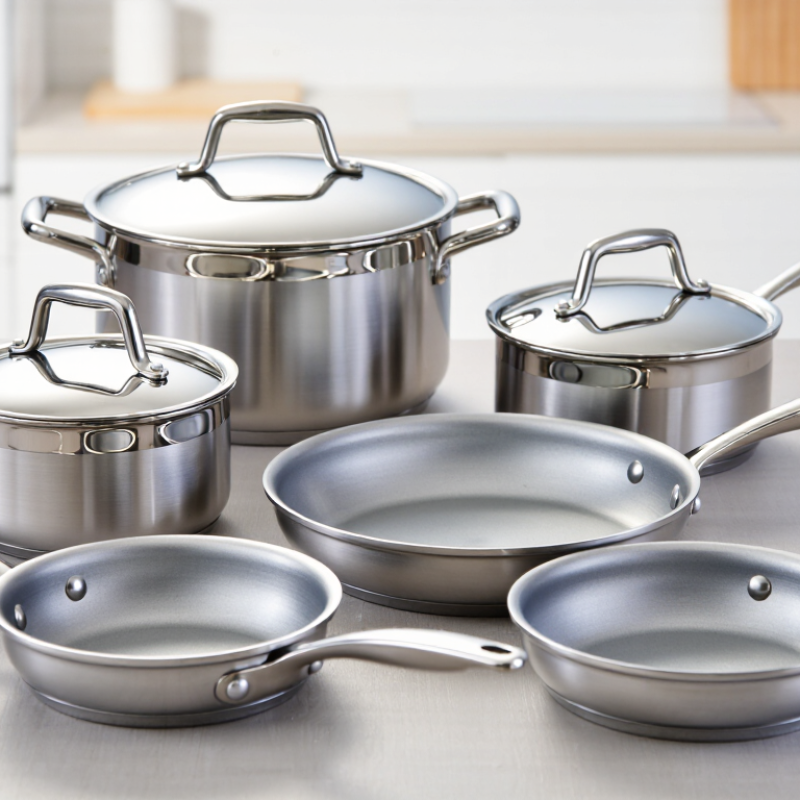
Tri-ply cookware sandwiches a heat-conducting core between two stainless steel layers. In many designs, aluminum forms the core, while stainless steel creates the cooking surface and exterior. Look at the rim: a visible layered edge can reveal the construction. Some pans carry the layered base only; fully clad pans extend the layers up the sides. That distinction matters.

The material contrast explains the design. ASM International materials data list thermal conductivity for 6061 aluminum at about 167 W/m·K, while type 304 stainless steel is roughly 16 W/m·K at room temperature. Values vary by alloy and temperature. Still, the aluminum core helps spread heat, while the steel surfaces provide a durable cooking contact. A useful check is whether the layers appear continuous around the pan, not just beneath it. I would not judge performance by thickness alone; bonding quality, pan shape, and burner size also affect heating. The construction is clever, but not magic.

Identify Your Cooking Needs and Essential Cookware Pieces

Start with your week, not a cookware set. The U.S. Bureau of Labor Statistics reported that Americans spent about 40 minutes per day on food preparation and cleanup in its 2023 American Time Use Survey. That time may involve a quick egg breakfast, a pot of rice, or a longer weekend meal. Write down what you actually cook for several days. The list can be revealing.

For frequent sautéing, choose a tri-ply skillet with enough room to keep vegetables in one layer. A medium saucepan handles oatmeal, grains, and small batches of sauce; a larger pot earns space if you regularly cook soup or pasta. The USDA Economic Research Service reported that food away from home made up 58.5% of U.S. food spending in 2023. That figure is a useful reminder: home cooking is not everyone’s daily routine, so buying a large set may not make sense. Not a showroom set.

Think about the details, too. A heavy pan can feel tiring when lifted full, and a wide skillet may not fit your storage shelf. Tri-ply construction can distribute heat across the cooking surface, but the right piece still depends on your stove, habits, and cleaning tolerance. It is easy to overestimate how often a stockpot will be used. I would check cupboard space before buying one.

How to Choose Tri Ply Stainless Steel Cookware? - Identify Your Cooking Needs and Essential Cookware Pieces

Cooking Need Essential Piece Useful Capacity or Size Why It Helps What to Check
Everyday frying, eggs, and quick meals Frying pan or skillet About 10–12 in (25–30 cm) Provides room to sear or sauté without crowding; a smaller pan can suit single servings. Look for a flat cooking surface, a comfortable handle, and fully clad construction if you want heat to extend up the sides.
Pasta, vegetables, grains, and boiling water Stockpot with lid About 6–8 qt (5.7–7.6 L) The larger capacity accommodates batches and leaves space for water to boil without overflowing. A multi-ply base can distribute heat across the bottom; check that the filled pot is manageable to lift.
Soups, sauces, oatmeal, and reheating Saucepan with lid About 2–3 qt (1.9–2.8 L) A versatile size for smaller portions and tasks that benefit from controlled stovetop heating. Check for a securely attached handle and a lid that fits well. Use moderate heat to reduce the risk of scorching.
One-pan meals, shallow frying, or cooking for several people Sauté pan with lid About 3–5 qt (2.8–4.7 L), typically 10–12 in (25–30 cm) Its broad base and straight sides offer room for browning ingredients and containing liquids. Consider the pan’s weight and whether its lid and handle are suitable for your cooking and storage needs.
Browning meat and finishing dishes in the oven Oven-safe skillet About 10–12 in (25–30 cm) Stainless steel can move from stovetop to oven when the cookware and its components are rated for the intended temperature. Verify the manufacturer’s oven-temperature limit, including limits for handles, lids, and knobs.
Cooking on induction or multiple kinds of stovetops Cookware with a magnetic stainless exterior or base Choose sizes that match your burner diameters Induction requires a magnetic cookware surface; compatible stainless cookware also works on many gas and electric cooktops. Check the cookware’s stated cooktop compatibility. A magnet sticking to the base is a useful preliminary induction check.
Building a compact starter collection Skillet, saucepan, and stockpot One practical size of each, matched to household portions These pieces cover many common tasks without requiring a large set of rarely used pans. Prioritize the pieces you use most, then add specialty cookware only when a recurring need justifies it.
Comparing tri-ply construction and upkeep Any frequently used tri-ply piece Compare thickness, weight, and construction details Tri-ply commonly combines stainless-steel cooking surfaces with an aluminum core for heat distribution; designs and performance vary. Confirm whether the layers extend up the sides or are limited to the base. Preheat gradually, use suitable cooking fat, and follow care instructions.

Compare Stainless Steel Grades and Core Materials

Stainless steel grades affect durability, corrosion resistance, and how cookware works on induction. Many tri-ply pans use 18/10 or 18/8 stainless steel for the cooking surface. These labels describe chromium and nickel content, not the pan’s overall quality. Both grades can resist rust well with ordinary care. A magnetic stainless layer on the outside is important for induction cooktops; 430 stainless steel is commonly used for this purpose. Check the product specifications rather than relying on a shiny finish. Appearance can be misleading. There is no single grade that makes every pan better, and I still find these labels easy to overthink.

The core material matters just as much. Aluminum spreads heat quickly, helping reduce hot spots when sautéing onions or warming a thin sauce. Copper also conducts heat well, though construction and core thickness affect real performance. In tri-ply cookware, these layers are bonded together, so inspect the pan’s cut edge or reliable construction details when available. Check the edge. A thicker core may improve heat distribution, but it can also make a pan heavier and slower to respond. Not always. Compare materials, weight, and intended cooking tasks together; grade numbers alone cannot tell you how evenly a pan heats or how comfortable it feels to lift.

How to Choose Tri-Ply Stainless Steel Cookware: Stainless Steel Grades and Core Materials

Approximate thermal conductivity at room temperature, in watts per meter-kelvin (W/m·K). Aluminum and copper conduct heat much more readily than stainless steel, which is why they are commonly used as the core in multi-ply cookware. Actual heating performance also depends on layer thickness, bonding, and pan design. Values vary by alloy and temperature.

Check Cooktop Compatibility, Handles, and Oven Safety

Tri-ply stainless steel cookware usually combines stainless steel layers with an aluminum core, but that does not guarantee compatibility with every cooktop. For induction, hold a magnet against the pan’s base: attraction is a useful quick check. Still, it is not the whole story. A warped or narrow base may heat unevenly or work poorly, so check the cookware specifications and make sure the bottom sits flat on the cooking zone.


The U.S. Department of Energy’s Induction Cooking Technology Assessment reports that induction cooking is about 5–10% more efficient than conventional electric resistance cooking and roughly three times as efficient as gas cooking. That makes a compatible magnetic base especially relevant if you are choosing pans for induction. On gas, keep flames beneath the pan rather than licking around its sides; this helps limit scorching on the exterior and excess heat on the handles.


Handle construction deserves a closer look. Metal handles can become hot, even when they feel cool during a short stovetop test. Check the maker’s stated oven-safe temperature for the entire pan, including lids and handle attachments; one component may have a lower limit. Wood, plastic, and silicone parts often restrict oven use. A sturdy rivet is reassuring, but it does not certify oven safety. I would verify the temperature limit before relying on appearance alone.

Evaluate Construction Quality, Care, and Overall Value

Tri-ply cookware usually sandwiches an aluminum or copper core between stainless-steel layers. The core spreads heat more evenly than stainless steel alone, but construction details still matter. Check that the layers extend across the cooking surface, not just the base. Inspect the rim and handle attachments for rough edges, gaps, or movement. Small details matter.

A pan should sit flat on your cooktop and feel balanced when lifted. Heavier construction can feel reassuring, yet it may be tiring to handle when full. That trade-off is easy to overlook. Heat performance also depends on burner size and how quickly you adjust the temperature; no pan prevents scorching if food is left unattended.

For care, use moderate heat, soak stuck-on food, and dry the pan after washing to limit water spots. Avoid harsh scouring pads that can dull the finish. Compare price with thickness, comfortable handles, oven-use guidance, and a clear care policy. A costly set is not automatically better value, especially if several pieces rarely leave the cupboard. Check individual pieces before buying.

FAQS

How should I choose my first cookware pieces?

Track what you cook for several days. A skillet, medium saucepan, and larger pot may cover your regular meals.

Do I need a complete cookware set?

Not necessarily. A large set can waste cupboard space if you rarely cook soups or pasta. Not always.

What should I look for in a skillet?

Choose one wide enough for vegetables to sit in a single layer. A tri-ply skillet can spread heat across its cooking surface.

How can I check whether a pan works on induction?

Hold a magnet against the base. Attraction is a useful quick check, but also confirm compatibility and a flat bottom.

Will a heavy pan be a problem?

It might feel tiring when full. Lift one in a store if possible; I would not judge by size alone.

How should I use cookware on a gas stove?

Keep flames beneath the pan. Flames reaching around the sides can scorch the exterior and heat the handles.

Are metal handles safe for oven use?

They can become hot. Check the stated oven limit for the entire pan, including its handles and lid.

Does a sturdy handle attachment mean a pan is oven-safe?

No. A strong rivet does not confirm oven safety. I have probably trusted appearance too much before; check the temperature limit.

Conclusion

Choosing Tri-Ply Stainless Steel Cookware starts with understanding its layered construction: stainless steel surrounds an aluminum or other conductive core to combine durability with more even heating. Consider how you cook and which pieces you use most, such as a skillet, saucepan, or stockpot, so your cookware set suits your everyday needs rather than adding unnecessary items.

Compare stainless steel grades and core materials for durability, heat response, and ease of care. Check that each piece works with your cooktop, has comfortable, securely attached handles, and is safe for the oven when needed. Finally, look for consistent construction, smooth edges, and practical care instructions. Weigh these qualities against the price and the number of useful pieces to judge overall value. A thoughtful comparison can help you choose cookware that fits your cooking habits and offers reliable performance over time.

Marielle

Marielle

Marielle is a highly experienced marketing professional dedicated to helping businesses communicate their value with clarity, confidence, and purpose. With a strong understanding of the company’s products, services, and customer needs, she transforms complex information into practical, engaging......