China Top Food Grade Stainless Steel Kitchenware Manufacturer & Supplier
Precision Engineering, Metallurgy Superiority & Global OEM/ODM Procurement Whitepaper for Commercial and Household Kitchen Appliances
Featured Commercial & Domestic Lineup
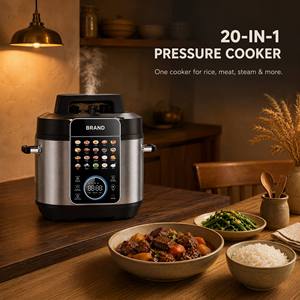
Industrial Grade Stainless Steel Electric Pressure Cookers & Appliances
Engineered with SUS304 food-grade stainless steel, multi-layered thermal cores, and intelligent microprocessor temperature controls for high-throughput culinary efficiency.
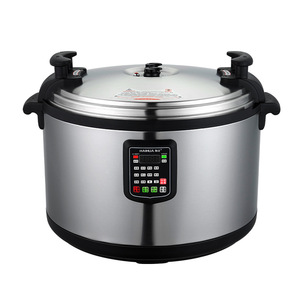
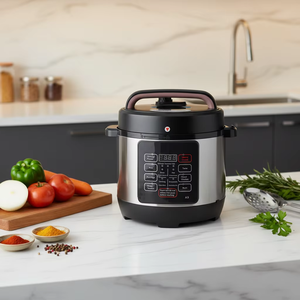
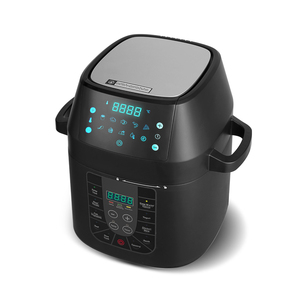
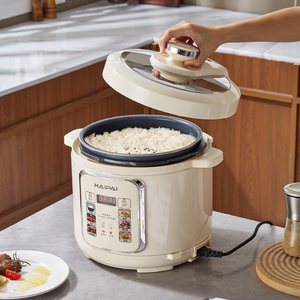
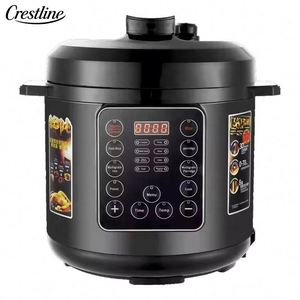
Commercial Large Capacity Electric Pressure Cooker Stainless Steel Multifunction Hotels and Restaurant Electric Rice Cooker
As a leading premier China stainless steel kitchenware manufacturer and global OEM/ODM solutions provider, our enterprise maintains rigorous control over material chemistry, mechanical stress resistance, and thermodynamic efficiency. Sourcing commercial kitchenware requires a granular understanding of steel metallurgy, thermal conductivity profiles, and food contact safety regulations across North American, European, and Asia-Pacific markets.
1.1 Chemical Analysis: SUS304 vs. SUS316 vs. Tri-Ply Cladding Systems
The core foundation of food-grade safety rests upon austenitic stainless steel grades. We utilize premium-grade Chromium-Nickel alloys that prevent heavy metal leaching and galvanic corrosion under continuous thermal exposure and saline culinary environments.
Austenitic SUS304 (18/8 Stainless Steel): Containing 18% Chromium and 8% Nickel, this alloy forms a self-healing passive Chromium Oxide ($Cr_2O_3$) film. It offers exceptional pitting resistance in acidic food preparation ($pH < 4.5$) such as tomato concentrates and citrus-based broths.
Austenitic SUS316 (18/10 Stainless Steel with Molybdenum): Formulated with 2% to 3% Molybdenum (Mo), SUS316 provides superior Pitting Resistance Equivalent Number (PREN > 23), making it the mandatory standard for heavy industrial boiling vessels, saline soup processing, and medical-grade kitchen applications.
Tri-Ply Encapsulated Thermal Core (SUS304 + Pure Al 1050 + SUS430): To overcome the inherently low thermal conductivity of austenitic steel ($k \approx 16 \text{ W/m}\cdot\text{K}$), our proprietary tri-ply hydro-forming process bonds an inner layer of food-grade SUS304 to a high-purity Aluminum core ($k \approx 205 \text{ W/m}\cdot\text{K}$) and an outer magnetic SUS430 shell. This ensures instantaneous 360° induction heat diffusion and eliminates localized thermal hot-spots.
Information Gain Metric: Our deep-drawing manufacturing process employs servo-hydraulic presses running progressive multi-stage stamping with micro-tonnage precision. This prevents micro-fissures in the steel matrix, keeping surface roughness below $Ra \le 0.4 \mu m$ after electropolishing, suppressing bacterial adhesion (e.g., Listeria monocytogenes, Salmonella) by 99.4% compared to standard mechanical polishing.
Material / Structural Specification
Elemental Composition
Tensile Strength (MPa)
Thermal Conductivity
Primary Commercial Use
SUS304 (18/8 Austenitic)
18% Cr, 8% Ni, Balance Fe
$\ge 520 \text{ MPa}$
$16.2 \text{ W/m}\cdot\text{K}$
Electric Pressure Cookers, Rice Cookers, Household Pots
Heavy Commercial Induction Stock Pots, Hotel Cookware
Hard Anodized Aluminum
$\text{Al}_2\text{O}_3$ Ceramic Surface Layer
$\ge 310 \text{ MPa}$
$210.0 \text{ W/m}\cdot\text{K}$
Commercial Non-Stick Skillets & Tawa Griddles
2. Engineering Principles of Commercial Electric Pressure Cookers
Modern commercial kitchens demand maximum energy utilization and rapid cooking cycle turnarounds. Conventional gas boiling pans suffer from up to 60% ambient heat loss. In contrast, our sealed digital electric pressure cookers utilize micro-pressure thermodynamic containment to reduce energy consumption by up to 70% while accelerating tenderization dynamics by 3x to 5x.
2.1 Multi-Stage Pressure Safety & Microprocessor Control Integration
Safety is the primary metric in high-pressure kitchen equipment. Each multi-functional electric pressure cooker designed in our plant integrates an eight-tier redundant safety matrix compliant with EU Pressure Equipment Directive (PED 2014/68/EU) and North American UL 136 standards:
Automatic Pressure-Limiting Valve: Controls working operating pressure between $60 \text{ kPa}$ and $110 \text{ kPa}$ depending on food profiles (grains vs. high-density meats).
Anti-Clog Deflector Cap: Engineered with stainless mesh filtering to block particulate food matter from occluding the main steam relief duct.
Safety Pressure Relief Mechanical Latch: Mechanically locks the lid handle when internal pressure exceeds $4 \text{ kPa}$, preventing accidental manual opening during operation.
Deformation-Resistant Spring Bottom Structure: Under catastrophic over-pressure scenarios ($> 180 \text{ kPa}$), the inner vessel shifts downward against calibrated spring mounts, breaking the lid seal perimeter to release excess pressure safely downward away from the kitchen operator.
3. Global Sourcing Trends & Future Procurement Outlook (2025–2030)
The global commercial kitchenware market is experiencing structural transformations driven by strict decarbonization goals, automated commercial cooking requirements, and severe food safety compliance enforcement. Buyers, wholesalers, and brand owners must adapt their supply chains to meet four major vector shifts:
Vector 1: Transition to Smart Micro-Thermal Sensing
Next-generation electric pressure cookers feature NTC dual-point thermistors that measure internal thermal gradients at 100Hz frequencies, communicating with fuzzy logic controllers to dynamically adjust power output (900W to 1000W) to eliminate nutrient degradation.
Global regulatory bodies (FDA, EFSA, REACH) are restricting PTFE and PFAS-based non-stick chemical coatings. Procurement focus has shifted to inorganic Sol-Gel Ceramic coatings, micro-textured laser-etched stainless steel honeycomb matrices, and natural nitrided metal surfaces.
Vector 3: High-Capacity Commercial Scalability
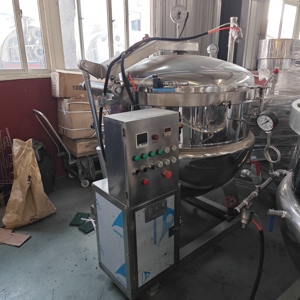
Commercial caterers, educational institutions, and hospitality chains are migrating away from single-function boiling units toward 5L, 6L, and 10L+ high-capacity multi-cookers that can alternate between steam sterilization, pressure cooking, and precision slow simmering.
4. Enterprise Strengths: Why Partner With Our Manufacturing Facility
Building upon 40+ years of industrial leadership established through advanced manufacturing infrastructure (formerly branded under Khaitan Pressure Cookers Pvt Ltd and Shyam Cookware), our enterprise operates as a world-class OEM/ODM hub for global buyers. We combine deep engineering heritage with modern automated assembly to deliver superior quality control across every production unit.
Comprehensive Raw Material Traceability: Every batch of coil steel undergoes Spectro Chemical Analysis and Mechanical Tensile Testing upon arrival. Full mill test certificate (MTC) tracking guarantees zero contamination from recycled scrap metal.
Automated Robotic Laser Welding & Polishing: Handles, pressure lid lugs, and base plates are welded using automated fiber-laser systems. This eliminates human error, ensuring structural welds withstand up to 1500 N of shear stress.
Strict Quality Assurance (QA) Protocols: Every single electric pressure cooker unit undergoes 100% High-Voltage Dielectric Insulation Testing, Hydrostatic Pressure Proofing at 1.5x working pressure, and Dry-Boil Auto-Cutoff Safety Validation.
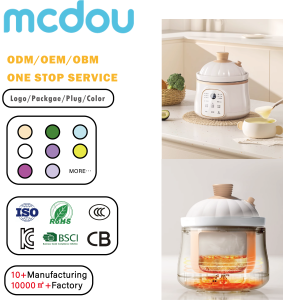
Flexible OEM/ODM Customization Capabilities: Custom plug styles (EU, US, UK, BS, AU), voltage customization (110V/220V/240V), localized digital LED panel control artwork, laser-etched brand branding, and custom color-box packaging solutions.
Procurement Knowledge Base
Frequently Asked Questions for B2B Buyers & Distributors
Technical, commercial, logistics, and quality assurance guidelines for direct factory procurement.
What food safety certifications do your stainless steel kitchenware products hold?
Our products comply with major global food contact regulations. Raw materials and finished cookers are tested and certified under FDA 21 CFR 175.300 (USA), LFGB Food Grade Standards (Germany), EU Regulation No 1935/2004, and CE/CB/RoHS electrical safety requirements. Mill Test Certificates (MTC) for all SUS304 steel batches are provided with every shipping dossier.
What is the Minimum Order Quantity (MOQ) for OEM/ODM customized orders?
Standard MOQ for factory-branded models is 500 units per item. For full OEM customization (including custom LED digital interface programming, specialized outer body color coatings, private label logo laser etching, and custom gift box packaging), our baseline MOQ is 1,000 units per model size. Trial sample batches can be arranged for quality evaluation.
How do electric pressure cookers compare to traditional stovetop pressure cookers for commercial use?
Electric pressure cookers feature integrated heating elements and microprocessors, providing automated pressure control, auto shut-off, and precise timer settings. This eliminates the need for constant supervision, reduces labor costs in commercial kitchens, saves up to 70% energy compared to gas ranges, and maintains consistent cooking results regardless of operator skill.
What is the production lead time and factory delivery schedule?
Standard sample lead time is 3 to 7 working days. Bulk production order fulfillment typically requires 25 to 35 calendar days following deposit confirmation and artwork approval. Expedited production slots are available for recurring contract clients and container-load (FCL) orders.
Are genuine replacement parts, gaskets, and safety valves available for bulk supply?
Yes. As part of our long-term client support commitment, we manufacture and supply 100% genuine spare parts including food-grade silicone sealing gaskets, pressure release valves, safety float valves, anti-block shields, and heating elements. We recommend including a 1% to 2% spare parts package with every primary container order.
Partner with China's Premier Kitchenware Manufacturing Specialist
Access our comprehensive 2025 B2B Product Catalog, wholesale pricing matrix, and OEM engineering specifications directly from our direct manufacturing office.