Executive Summary & The Physics of Piezo Electric Kitchen Lighters
In the highly competitive global kitchenware ecosystem, the Piezo Kitchen Lighter represents a critical category defined by high inventory turnover, recurring retail demand, and stringent safety requirements. Unlike liquid-fueled butane lighters or battery-operated electronic sparkers, a piezo kitchen lighter operates on the fundamental physical principle of piezoelectricity—converting instantaneous mechanical force into a high-voltage electrical spark without external power sources, fuel reservoirs, or chemical consumables.
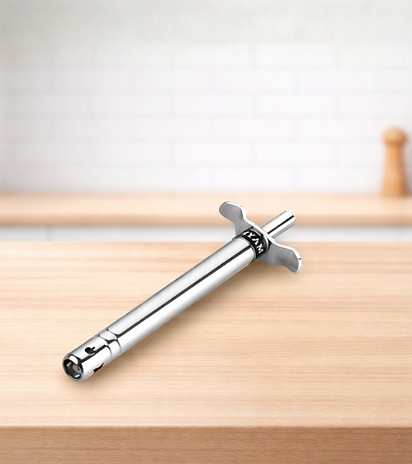
For global procurement executives evaluating bulk sourcing contracts, understanding the underlying material science is vital. The core of a high-performance kitchen lighter is a precision-engineered Lead Zirconate Titanate (PZT) ceramic crystal. When the user depresses the heavy-duty spring-loaded trigger mechanism, a hardened steel hammer strikes the PZT element with calculated impact force. This mechanical shock temporarily distorts the non-centrosymmetric crystal structure, forcing a massive dipole alignment that generates a instantaneous voltage differential ranging from 10,000 to 15,000 Volts (10kV–15kV) across the spark gap located at the tip of the stainless steel barrel.
This high-voltage arc ionizes the surrounding air gap between the central electrode and the grounded outer chrome-plated shaft, creating an instant thermal spark capable of igniting Liquefied Petroleum Gas (LPG), Piped Natural Gas (PNG), Methane, and Propane-air mixtures. Because gas-air mixtures require a minimum ignition energy of approximately 0.25 millijoules, a high-density PZT crystal manufactured to strict tolerances guarantees instant single-click ignition across varying ambient humidity and pressure conditions.
Why B2B Buyers Are Accelerating the Shift to Piezo Ignition
Over the last five years, global procurement data indicates a decisive movement away from disposable fluid gas lighters toward piezo-electric spark lighters. The driving factors behind this global sourcing transition include:
- Zero Dangerous Goods (DG) Freight Surcharges: Piezo lighters contain zero flammable liquids or compressed gases under pressure. Consequently, international ocean container and air freight shipping fall under standard Class 9 or non-hazardous cargo classification, eliminating HAZMAT documentation costs, expensive port handling fees, and storage restrictions.
- Unrivaled Shelf Life & Storage Stability: Fuel-based lighters suffer from micro-leakage of butane seals during trans-oceanic transit, leading to high return rates and dry-inventory stockouts. Piezo ceramic igniters retain 100% operational functionality even after years of warehouse storage under extreme temperatures.
- Enhanced Commercial Safety: Restaurant chains, hotel kitchens, and domestic consumers increasingly prioritize zero-flame spark lighters to eliminate burn hazards, open flame flare-ups, and accidental fuel leaks near commercial gas ranges.